Why Your Brain is Trained to be Distracted

As a leader, you’ve probably caught yourself thinking: “I just can’t focus like I used to” or “There’s never enough time to think strategically”
You might assume the problem is discipline, motivation, or poor time management.
The neuroscience suggests otherwise.
According to recent insights from Stanford researchers, many of today’s high-performing leaders are not suffering from a lack of willpower. You are operating in environments specifically designed to hijack your brain’s attention systems.
The Modern Workplace Is Competing Against Human Evolution
Your brain evolved to notice novelty. For your ancestors, paying attention to new sounds, movements, or opportunities increased survival. Today, that same neurological wiring is being activated hundreds of times per day by emails, texts, social media notifications, and news alerts.
Every notification creates a small dopamine reward. Over time, your brain becomes conditioned to seek these quick wins because they require almost no effort. Deep work, strategic thinking, problem solving, and innovation require significantly more metabolic energy, making them feel increasingly difficult by comparison.
Here’s the truth: you’re not struggling because you lack commitment. You’re struggling because your brain has been trained to prefer constant stimulation over sustained concentration.
Why Willpower Isn’t Enough
Many leaders attempt to solve the focus problem through sheer determination. You promise yourself you won’t check email, won’t look at your phone, and won’t get distracted.
Unfortunately, neuroscience suggests this approach is fundamentally flawed.
Every act of resisting temptation consumes cognitive resources. Throughout your day, you repeatedly spend mental energy fighting distractions, leaving less capacity available for critical thinking, decision-making, and creativity. Eventually, attention fatigue sets in.
The Stanford team recommends a different approach called proactive control.
Instead of resisting distractions, remove them before they appear:
- Put your phone in another room during strategic work
- Disable unnecessary notifications
- Schedule blocks of uninterrupted thinking time
- Use website and app blockers when needed
- Create physical environments designed for focus
The lesson is simple: your success is less about resisting temptation and more about designing environments where temptation is absent.
Attention Is a Strategic Leadership Asset
Many executives underestimate how much attention drives performance. Strategic planning, innovation, emotional intelligence, coaching conversations, and complex decision-making all depend upon your ability to maintain focus on what matters most. When attention becomes fragmented, you become reactive rather than intentional. You spend more time responding and less time thinking.
Ask yourself: “What percentage of my day is spent directing my attention versus having my attention directed by others?”
Your answer likely reveals a significant leadership opportunity.
The Importance of Recovery
Focus is not simply a mental skill—it’s a biological resource.
Your brain requires recovery periods to sustain performance. Sleep remains the most important recovery mechanism because it consolidates memories, restores cognitive capacity, and prepares your brain for the next day of high-level thinking.
During the workday, short recovery periods are equally important. Stanford clinicians recommend brief breaks throughout the day to restore attention and cognitive processing speed.
This finding aligns closely with the Academy of Brain-based Leadership’s NETS™ Model—a framework that recognizes four essential pillars for optimal brain performance:
- Nutrition supports your brain’s energy demands
- Exercise improves blood flow, neuroplasticity, and stress resilience
- Mindfulness Training strengthens attentional control and emotional regulation
- Sleep restores cognitive function and consolidates learning
When you neglect any of these four pillars, your ability to sustain attention declines. Focus, therefore, should not be viewed solely as a productivity issue, but rather a fundamental brain health issue.
Flow: Your Hidden Competitive Advantage
Perhaps the most interesting insight from Stanford’s work involves the concept of flow.
Flow occurs when your attention becomes fully absorbed in a meaningful challenge. During these periods, distractions fade into the background, productivity increases, and performance often reaches its highest levels. Researchers describe self-hypnosis and visualization techniques as methods for intentionally entering these highly focused states.
While the term “hypnosis” may sound unusual in executive settings, the underlying principle is familiar: directing attention deliberately toward a specific goal while reducing competing mental noise.
Elite athletes, performers, and high-achieving executives frequently use visualization practices to improve concentration and execution. Creating the conditions for flow may be far more valuable than implementing another productivity hack.
Taking Action
The next time you find yourself unable to focus, move beyond self-criticism about discipline. Instead, explore:
- What distractions are competing for your attention?
- How is your environment shaping your behavior?
- Are you relying too heavily on willpower?
- Are you protecting time for deep work?
- How well are you managing the NETS™ pillars of Nutrition, Exercise, Mindfulness Training, and Sleep?
- Do you have regular opportunities to enter flow states?
The most effective leaders are not necessarily those with the strongest willpower. They are the ones who understand how their brains work and intentionally build environments that support sustained attention.
In a world increasingly designed to fragment focus, the ability to direct your attention may become one of the most valuable leadership skills of all.
Reference: Stanford Medicine, “How to concentrate in an ever-distracted world” (2026). Available at med.stanford.edu.
—
Want to start your brain-based leadership development journey?
Join us for leader focussed workshops with Leading to SAFETY™
Trending

Psychological Safety Book
May 30, 2018Related
AI Can’t Fix a Psychologically Unsafe Culture at Work
October 5, 2026AI and the Brain: Answering the Questions Everyone’s Asking
September 7, 2026Share Post



TEDx: The struggle between the emotional and logical brain
In this TEDx talk Dan Radecki explores the idea that our modern brain can over ride our caveman brain.

Improve team performance through psychological safety
Harness the power of neuroscience and build a psychologically safe culture where people thrive, connect, and perform at their best.

Overcoming pandemic panic
Learn about your brain's operating principles, its natural response to uncertainty and unpredictability and some scientifically proven strategies to better manage stress and emotions, and boost your brain health and resilience.

Build trust and belonging – connection through vulnerability
Learn how to leverage neuroscience to effectively build trust and belonging like Herman Miller who has embedded the concept of psychological safety to cultivate connection across their business.

Enhancing diversity, inclusion & belonging
Learn why traditional diversity training is ineffective and why both visible and invisible diversity are critical to building inclusion and belonging.

Building mental and physical wellness & resilience
Understand the brain-based strategies to mitigate the negative impact of stress and build mental and physical health and resilience.

Resilience training that can change the brain
Understand the latest research on behavioral and cognitive strategies that cultivate resilience and change the brain.

The science behind training effectiveness
Science gives us insights into how humans work so we can avoid training pitfalls while creating new and innovative ways to help people develop to their full potential.
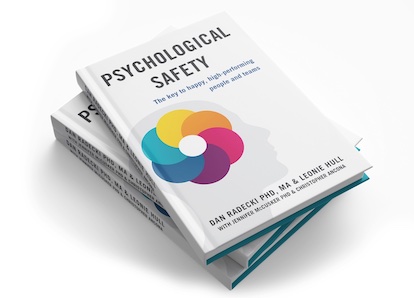
Both academic and industry research identify Psychological Safety as the number one determining factor of successful people and teams. However, until recently we lacked the ability to measure, track or implement strategies for something so intangible and subjective. Thanks to neuroscience research we are now gaining this visibility. This book translates the research to provide valuable insights into the brain – the importance and impact of psychological safety and the strategies to protect and build it personally and collectively.
Learn More
The S.A.F.E.T.Y.™ Model describes six domains of threat or reward that are important to the brain: Security, Autonomy, Fairness, Esteem, Trust and You. Understanding the needs, rewards, motivations, biases and stress triggers of each domain can provide valuable insights into yourself and others and help improve interactions, teamwork and productivity. The S.A.F.E.T.Y.™ assessment ranks and quantifies your brain’s S.A.F.E.T.Y.™ needs and explores the potential impacts of your profile on you and those around you.
Learn More